Adelaide Hills vineyard tours: walk through the vines and see how wine is made
Adelaide Hills vineyard tours compared, from The Lane's A$350 winemaker-led ATV drive and Golding's A$130 Wine Safari to e-bike rides and vineyard horse treks, with what you see in each season and what to check before you book.
A vineyard tour takes you out of the tasting room and onto the property, to see where the grapes grow and often how the wine is made. In the Adelaide Hills the options run from Golding’s A$130 Wine Safari and The Lane’s A$350 winemaker-led ATV drive to guided rides through the countryside. The easiest of these to book from a listing is the Hahndorf food and wine E-Bike Tour: about five hours by e-bike from The Lane Vineyard near Hahndorf, with a Shaw + Smith flight, a tasting at The Lane and a cheese board, from $189 per person and rated 5.0/5 from 59 Viator reviews. The dates below are for that tour.
Check Availability
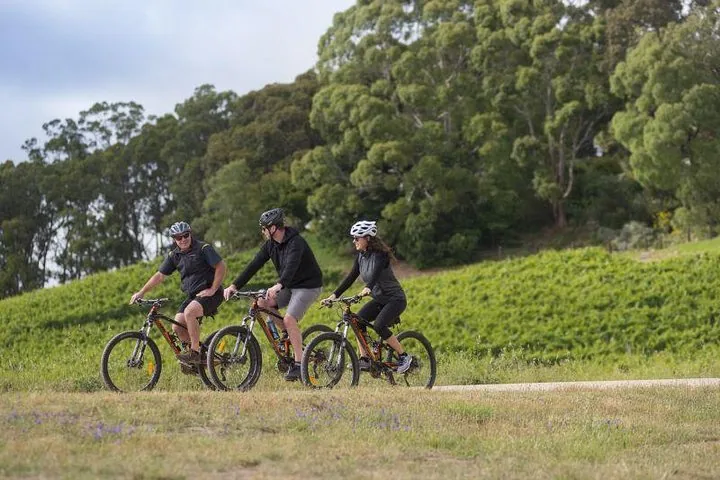
Hahndorf food and wine E-Bike Tour
- 5.0/5 (60+ reviews)
- 5 hours
- Free cancellation
- Operated by Bike About
Includes E-bike hire and local guide · Pannier bags for produce and wine · Wine flight at Shaw and Smith
You'll choose your date and complete the booking on Viator. Free cancellation up to 24 hours before departure.
Same ride, also on GetYourGuide
From $186 per person · ★ 4.9 from 6 GetYourGuide reviews
Each platform sets its own price and collects its own reviews, so compare both before you book on Viator.
If you want to understand Adelaide Hills wine as well as drink it, book at least one experience that gets you into the vineyard. The Hills show the link between landscape and wine better than most of South Australia: steep slopes, changing elevation, cool nights and many small vineyard sites all shape what ends up in your glass.
Some experiences are relaxed walks through the vines. In others a winemaker drives you across the estate, you taste a wine beside the block its grapes came from, step into the winery for a barrel sample, or pair the finished wine with food.
- For the fullest vineyard visit: The Lane’s Ultimate ATV Experience
- For relaxed vineyard exploring: Golding Wines’ Wine Safari
- For serious wine drinkers: a winery and vineyard tour that includes the production side
- On a budget: a standard cellar-door tasting at a winery that lets you walk or look out over its vines
- To see green vines: roughly spring through early autumn
- For wine geeks: vintage, generally late summer into autumn, although working areas may be off limits
“Winery tour”, “vineyard tour” and “wine tasting” mean different things, so check which one you are booking.
Vineyard tour, winery tour or wine tasting?
Before booking anything, check what the experience includes.
| Experience | What you usually do | Best for |
|---|---|---|
| Wine tasting | Sit or stand at the cellar door and taste several wines | First-time visitors, shorter stops |
| Vineyard tour | Go among the vines and learn about grape growing | People curious about where wine comes from |
| Winery tour | See production areas, tanks, barrels or winemaking equipment | Wine enthusiasts |
| Vineyard and winery experience | Follow the wine from vine to production to bottle | The fullest education |
| Food and wine experience | Taste wine with matched food, sometimes after a vineyard walk or drive | Couples, celebrations, slow afternoons |
| Private vineyard experience | Dedicated host or winemaker, small group, premium wines | Serious wine lovers |
A standard flight tells you what a winery makes. A good vineyard tour starts to explain why it tastes that way, and the Adelaide Hills are a good place to learn it.
A standard tasting keeps you at the cellar door. A vineyard experience takes you onto the property to learn how altitude, slope, soil and climate affect the grapes, and a winery tour goes one step further, showing how those grapes are fermented, matured and bottled.
If you are staying a few days around Adelaide, you can also book Hahndorf food tours, Barossa Valley and McLaren Vale wine days, and trips to Mount Lofty and Cleland Wildlife Park.
Why the Adelaide Hills suit vineyard tours
You can read “cool climate” on a bottle of Adelaide Hills Chardonnay in a shop. Standing in the vineyard makes the words concrete.
The Hills rise through the Mount Lofty Ranges, and vineyard sites reach real height. Sidewood describes Adelaide Hills elevations of around 600 metres, with its vineyards noticeably cooler by day and night than Adelaide and the warmer South Australian wine regions around it. That cooler growing season gives the fresh acidity and slow ripening found in many Adelaide Hills wines.
The landscape also changes quickly. One vineyard can differ from another nearby in:
- elevation
- slope
- aspect
- sunlight
- soil
- rainfall
- wind
- drainage
Sidewood notes that rainfall varies from around 1,400 mm near Mount Lofty to about 850 mm around Charleston, and that soils range through sandy loams, loams and clay loams. So the Hills are not one uniform vineyard zone, and a vineyard visit means more here than at a winery whose grapes grow hundreds of kilometres away.
The best Adelaide Hills vineyard experiences
1. The Lane Vineyard Ultimate ATV Experience
Best for: the most complete vineyard-to-glass visit
If you want to get deep into a property and not just look at vines from a terrace, The Lane near Hahndorf runs one of the most substantial experiences in the Hills. Its Ultimate ATV Experience takes you across the estate in an ATV with a winemaker. You taste premium single-vineyard wines in the vineyard they come from, with food from The Lane’s kitchen, then visit the winery for a barrel tasting before a paired main course and dessert.
- Duration: about 3 hours, 11am to 2pm
- Price: A$350 per person
- Group size: 2 to 4
- Runs: Monday, Thursday and Friday (no public holidays)
- Season: September to January
- Includes: guided estate drive, vineyard tasting, barrel tasting and food
- Suits: couples, serious wine drinkers, special occasions
It is not a cellar-door add-on; it takes up half the day. You book it direct with The Lane, as it is not sold through the tour platforms.
Is it worth A$350?
Not if you only want to taste The Lane’s wines: the tasting room flights start at A$20. If you care about single-vineyard wines, terroir, winemaking, barrel tasting, food pairing or time with the person who makes the wine, the price is easier to justify. You are paying for access and time more than for extra wine.
2. Golding Wines Wine Safari
Best for: exploring the vineyard without a technical masterclass
Golding Wines suits you if the vineyard itself is the draw. The Adelaide Hills Wine Region lists vineyard tours among Golding’s activities and names its Wine Safari, A$130 per person for about two and a half hours. The safari takes you out from the tasting room at the Western Branch vineyard near Lobethal, deeper into the property, stopping to taste wine and food along the way. Australian Traveller describes it the same way: an exploration of the property with stops for wine and snacks.
The longer Pinnacle version continues into a seasonal lunch for A$275 per person. Both are booked direct with Golding.
Choose it if you want something:
- more memorable than a wine flight
- less formal than a technical winery tour
- outdoors
- scenic
- easy-paced enough for a couple’s day
The setting is part of the appeal. Golding’s cellar door and Ginkgo Restaurant sit on the Western Branch Vineyard outside Lobethal, with tastings in a historic sandstone barn.
Who should choose it?
Pick this kind of experience if your question is “Can we go into the vineyard instead of just sitting and looking at it?” and not “Can someone explain every stage of malolactic fermentation?” It puts vineyard sightseeing first and technical wine education second.
3. Shaw + Smith: vineyard and winery perspective
Best for: people who care how a vineyard site turns into serious wine
Shaw + Smith ties its Adelaide Hills identity to estate vineyards and cool-climate varieties. Its holdings in Balhannah and Lenswood cover around 55 hectares, according to recent coverage, with Sauvignon Blanc, Chardonnay, Pinot Noir and Shiraz at the centre of production.
For the right visitor this beats an elaborate experience with lots of extras, because Shaw + Smith gives you a clear view of four major Adelaide Hills styles:
- Sauvignon Blanc
- Chardonnay
- Pinot Noir
- cool-climate Shiraz
The Balhannah winery runs hosted experiences, and recent visitor information describes chances to tour the winery and vineyard beyond a standard tasting. Shaw + Smith requires bookings for its tours, which you make on its reservations page. Choose it if the wine matters more to you than the photo.
4. Sidewood Estate: how one producer works several sites
Best for: seeing how one winery uses several Hills vineyards
Sidewood’s wines do not come from one patch of ground. The producer describes several Adelaide Hills vineyards, including:
- Charlie’s Patch, Charleston: 28 hectares
- Mappinga, Oakbank: 47 hectares
- Winery Vineyard, Nairne: 4.8+ hectares
- Ironstone Road, Echunga: 25 hectares
The plantings vary too. Across those vineyards you find:
- Pinot Noir
- Chardonnay
- Sauvignon Blanc
- Pinot Gris
- Shiraz
- Pinot Blanc
The Nairne winery vineyard is planted entirely to Shiraz and has been certified organic since 2022, while the other sites differ in exposure, plantings and location. So at the tasting, your question shifts from “Which wine do I like?” to “Why does this variety grow here?”
5. Petaluma: a horse ride through the vines
Best for: people who would rather ride than walk
The Petaluma: Horseback Riding and Wine Tasting Tour is a 45-minute guided trail ride through a Petaluma vineyard site with horses from Hallmark Farm in Woodside, followed by a guided tasting of Petaluma and Croser wines at the cellar door. It costs from $147 per person and is rated 5.0/5, though from only 10 reviews so far.
What do you learn on a vineyard tour?
A good vineyard tour is more than a scenic walk beside the vines. You should come away understanding at least some of the following.
Why vineyards are planted where they are
Wine grapes need more than sunshine. Growers think about:
- altitude
- slope
- frost risk
- drainage
- prevailing wind
- soil
- access to water
- orientation to the sun
A north-facing slope can behave differently from a cooler, shaded block nearby, and in the rolling Adelaide Hills those differences can be very local.
Why Adelaide Hills grapes ripen differently
Cooler nights help grapes keep their acidity while flavours develop. That matters most for:
- Chardonnay: valued for acidity, citrus and stone fruit, with richer examples gaining texture from barrel fermentation and ageing.
- Pinot Noir: a famously site-sensitive grape that prefers cooler conditions than Australia’s warmer inland areas.
- Sauvignon Blanc: one of the varieties long tied to the Adelaide Hills, usually fresh and aromatic.
- Shiraz: fresher, more savoury and peppery here than the powerful Shiraz of warmer regions.
A vineyard guide can show you why one slope carries Pinot Noir and another Shiraz, and the tasting afterwards makes more sense. Our Adelaide Hills Pinot Noir guide goes further into the region’s best-known red.
What happens in the vineyard during the year?
Vineyards look very different from one season to the next, which is a good reason to come back.
Winter: June to August
The vines are mostly dormant. Expect bare vines, pruning, quiet vineyards and cellar-door fireplaces. If you want rows of lush green vines, this is not the time. Winter does help you understand how a vineyard is built, though, because you can see the trunks, canes and trellising.
Spring: September to November
The vineyard comes back to life. You see budburst, new green shoots, fast canopy growth and, later in spring, flowering. For a first vineyard-focused visit, spring is excellent: everything is growing and the summer heat has not arrived.
Summer: December to February
Now the vineyard looks like the postcard. You see full green canopies, developing bunches, fruit changing colour later in the season and plenty of vineyard work. It is the most photogenic period and good for outdoor tastings, although hot days make long walks less appealing.
Vintage: roughly late summer into autumn
This is the best time if winemaking fascinates you. Depending on variety, site and season, grapes start arriving at the wineries and you may see picking, bins of grapes, crushing, pressing, busy tanks and winery teams working long hours.
Vintage is not the easiest time to tour a working winery, though. Production comes first, and areas that are normally open may be closed for safety or because staff are flat out. Don’t book a March visit expecting a walk through an active winery; ask first.
Autumn: March to May
After harvest the vineyards change colour. This is one of my favourite times for an Adelaide Hills wine trip, with cooler weather, autumn foliage, a post-vintage mood, good food and fine scenery. By late autumn the vines head back towards dormancy.
When is the best time for an Adelaide Hills vineyard tour?
It depends what you want to see.
| Period | What the vineyard looks like | Best for |
|---|---|---|
| Jun–Aug | Dormant, bare vines | Wine education, cosy cellar doors |
| Sep–Nov | Fresh growth | Walking, scenery, vineyard learning |
| Dec–Feb | Lush and green | Photos, outdoor experiences |
| Feb–Apr | Ripening and harvest | Winemaking interest |
| Apr–May | Autumn colours | Scenery, couples, photography |
Best overall: October to April
If your picture of a vineyard tour has green rows of vines in it, avoid midwinter.
Best for seeing grapes: late summer
Exactly what you see depends on the variety and the vineyard.
Best for comfortable walking: spring and autumn
The Hills can feel noticeably cooler than Adelaide, so bring a layer even when the city is warm. Our best time to visit page has the month-by-month weather.
Can you walk through vineyards without booking a tour?
Sometimes, but never assume the vine rows are open to the public. A vineyard is a working farm, and there may be:
- machinery operating
- vineyard sprays
- uneven ground
- irrigation equipment
- electric fencing
- private homes
- biosecurity rules
A cellar door that overlooks vines does not give you the run of them. Ask staff where visitors may go, or book an experience that names vineyard access in its description.
Vineyard tour or winery tour: which should you pick?
If you only have time for one, pick by what you are curious about.
Choose a vineyard tour if you want to understand:
- grape growing
- climate
- terroir
- vineyard sites
- landscape
- why particular grapes do well here
Choose a winery tour if you want to understand:
- fermentation
- pressing
- barrels
- oak
- blending
- winemaking equipment
Choose a combined experience if you love wine
This gives you the most, because wine makes far more sense when you see the whole sequence: vine, grape, winery, barrel or tank, bottle, glass. The Lane’s ATV experience follows that sequence literally, moving from the vineyard into the winery for a barrel tasting and finishing with food and finished wine.
Does it actually go into the vineyard?
| Winery | Vineyard access | Winery access | Barrel tasting | Food | Duration | Price |
|---|---|---|---|---|---|---|
| The Lane, Ultimate ATV | Yes | Yes | Yes | Yes | 3 hours | A$350 |
| Golding, Wine Safari | Yes | Not stated | Not stated | Yes | About 2.5 hours | A$130 |
| Shaw + Smith, tours | Tour dependent | Tour dependent | Tour dependent | Available separately | Varies | Check when booking |
What is a barrel tasting?
Instead of a bottled wine, you taste a sample still ageing in barrel, so you meet the wine while it is still developing. Depending on the wine, it can seem:
- less integrated
- more obviously oaky
- more tannic
- more acidic
- less polished
That is the point: you are tasting the wine halfway through being made. The Lane includes a barrel tasting in its ATV experience. If you already enjoy wine, I would value that more than two extra finished wines in a premium flight.
Are vineyard tours good for people who know nothing about wine?
Yes, often more than a serious tasting is. Wine language gets abstract quickly. Someone can tell you a wine shows cool-climate character, site expression, high natural acidity, eastern exposure and restrained ripeness, and none of it means much to a beginner.
Standing on a cool hillside while someone shows you where the fruit grew makes the explanation tangible. You don’t need to know about grape clones, fermentation temperatures, oak origin or soil chemistry before you go. A good guide translates instead of lecturing.
Are Adelaide Hills vineyard tours good for couples?
Very. Given the choice between five quick cellar-door tastings and two good tastings plus one proper vineyard experience, I would pick the second for a couple’s day out. After the third standard tasting, wineries start to blur together; a vineyard visit changes the rhythm of the day.
For couples, look for:
- scenic vineyard exploring
- food and wine pairing
- private or semi-private touring
- vineyard picnics
- a winery lunch after the tour
- sunset or late-afternoon vineyard views where offered
Golding suits couples who want the vineyard itself to be part of the outing, with one catch: the Wine Safari needs at least four guests, so a couple on its own books the Perch, a hosted tasting and grazing box for two to four. More ideas for two are in our guide to Adelaide Hills wineries for couples. For lunch to follow, see our guide to Adelaide Hills wineries with lunch.
Are vineyard tours suitable for children?
It varies a lot. Some Adelaide Hills cellar doors welcome families, but that does not make a vineyard tour suitable for children. Check:
- the minimum age
- uneven terrain
- moving farm machinery
- whether alcohol is central to the experience
- the tour length
- whether children need paid tickets
High-end experiences may be adults-only or simply unsuited to children by their format. A three-hour winemaker-led ATV, barrel and wine experience is plainly aimed at adults.
For a family day, a winery with lawns, outdoor tables, food and short tastings may suit you better. The Adelaide Hills Wine Region profile lists Golding as family friendly, with large lawns.
What shoes should you wear?
If you are going into a vineyard, leave your best white trainers at home. Expect dirt, gravel, mud, grass and uneven slopes. Wear closed shoes with good grip, and in winter or after rain choose something you don’t mind getting muddy. For an ordinary cellar-door tasting, normal casual clothes are fine.
Do vineyard tours run in rain?
Sometimes. A light shower may just mean an umbrella, a jacket or a changed route, but heavier weather can stop the outdoor parts. Tours with vineyard vehicles or rough ground may be changed or cancelled if conditions are unsafe.
If the tour is the main reason for your trip, check the operator’s wet-weather policy, cancellation terms and rescheduling policy before you book.
What does an Adelaide Hills vineyard tour cost?
The range is wide, because “vineyard experience” can describe very different products.
Simple vineyard access or an informal walk
Often included with a tasting, or free where it is allowed.
Guided vineyard and wine experience
Roughly A$50 to A$150 or more is a reasonable planning range. Golding’s Wine Safari is A$130.
Vineyard experience with food
Expect A$100 to A$200 or more, depending on length and inclusions. Golding’s Pinnacle version with lunch is A$275.
Private or highly immersive experience
A$200 to A$350 or more per person. The Lane’s three-hour winemaker-led ATV experience is A$350 per person.
That is far more than an A$20 to A$30 cellar-door tasting, but they are different products. Our Adelaide Hills wine tasting cost guide breaks down the standard tasting fees.
Is a vineyard tour worth the extra money?
For your first winery of the day, often yes. For your fourth, probably not.
Pay extra for an experience that gives you real access to:
- vineyards
- winemaking areas
- the winemaker or viticulturist
- barrel samples
- single-vineyard wines
- food
Be wary of paying a big premium for an “experience” that amounts to a normal tasting with a better chair and a nicer view. Read the inclusions carefully.
A vineyard-focused Adelaide Hills day
Don’t book three vineyard tours; you will hear versions of the same introduction each time. A better day looks like this:
- 10:00–10:30, arrive in the Hills: head straight to your most immersive experience.
- 10:30–12:30, vineyard or winery tour: learn how the region works while your palate is fresh.
- 12:30–2:00, winery lunch: stay somewhere with vineyard views.
- 2:15–3:15, second cellar door: apply what you learned to a normal tasting.
- 3:30–4:30, final tasting: choose something different in style.
For the afternoon, compare a polished larger estate, a small producer and a Pinot Noir or Chardonnay specialist. You get more variety than from five tasting counters. For a full one-day route with transport and timings, see our Adelaide Hills winery day trip from Adelaide.
Do you need a car?
For most independent vineyard visits, yes, or another way to get around. Adelaide Hills wineries are spread across towns and rural roads; there is no single walkable wine village. And don’t plan to drive after a real tasting session.
Your options:
- an organised wine tour
- a private driver
- a taxi or rideshare where available
- a designated driver
- a hop-on hop-off bus
TrailHopper runs a Hahndorf and Adelaide Hills loop that it says links stops including Hahndorf Hill, Shaw + Smith, Nepenthe, Murdoch Hill, Artwine, Bird in Hand and Sidewood. Our pick for it is the Adelaide Hills & Hahndorf Hop-On Hop-Off Wine Tour, from $71 per person (4.8/5 from 150+ reviews). It gives you freedom without a car, but it is transport between venues, not a vineyard tour. Our page on wineries without a car compares the alternatives.
Want the vineyards without organising the driving?
A guided wine tour is usually the easiest option if everyone in your group wants to taste. Compare tours by group size, wineries visited, tasting inclusions and lunch, not just the headline price. Our pick for a first day is the Hills & Hahndorf Hideaway, from $175 per person (4.8/5 from 200+ reviews), with tastings at The Lane and Sidewood and lunch in Hahndorf. It stops at cellar doors and does not go into the vineyards; the best Adelaide Hills wine tours compares the rest.
Can you cycle between Adelaide Hills wineries?
Yes, on specialist tours. The Hahndorf food and wine E-Bike Tour starts at The Lane Vineyard, rides through the countryside around Hahndorf and includes a Shaw + Smith flight, a tasting at The Lane, an Udder Delights cheese board and seasonal strawberry picking at Beerenberg, over about five hours. It costs from $189 per person and is rated 5.0/5 from 60 reviews; our e-bike tour breakdown has the details.
It is a good way to take in the landscape, but cycling and alcohol still need sensible planning. Not driving a car is no reason to drink heavily on a bike.
Which wines to look out for on a vineyard tour
Chardonnay
Possibly the variety that best shows what cool-climate Adelaide Hills means. Ask:
- Which direction does the block face?
- How high is it?
- When was it picked?
- Was it fermented in barrel?
- How much new oak was used?
Pinot Noir
Useful for vineyard talk because Pinot is so sensitive to site. Ask whether the winery uses:
- one estate block
- several clones
- fruit from different subregions
Sauvignon Blanc
Adelaide Hills Sauvignon Blanc is central to the region’s modern identity. Taste one in the vineyard and the talk tends to move from generic “tropical Sauvignon” towards:
- ripeness
- picking date
- canopy management
- acidity
- site
Shiraz
A useful comparison if you have also visited the Barossa or McLaren Vale. Adelaide Hills Shiraz comes from a much cooler environment, so look for pepper, spice, red and black fruit, freshness and savoury character, and don’t expect every South Australian Shiraz to be rich, heavy and jammy.
Questions to ask your vineyard guide
You don’t need technically impressive questions. These get better answers:
- Why was this grape planted in this spot?
- What makes this vineyard cooler or warmer than another site nearby?
- Which grape is hardest to grow here?
- Which block produces your favourite wine?
- What changes most from one vintage to the next?
- Do you hand-pick or machine-pick?
- How do you decide when the grapes are ready?
- Where does the fruit go after it is picked?
- Can I taste a wine made from the block we are standing in?
- What do visitors most often get wrong about Adelaide Hills wine?
That last question usually starts a better conversation than asking for a rehearsed description of terroir.
How grapes become wine: the short version
A vineyard tour is easier to follow if you know the basic sequence.
1. Grow
The vineyard team manages the canopy, crop size, disease and water through the growing season.
2. Ripen
Sugar rises, acidity changes and flavours develop.
3. Pick
Timing is one of the biggest decisions. Earlier picking keeps more acidity; later picking gives riper flavours and more sugar.
4. Crush and press
White and red grapes are usually handled differently. For many white wines the juice is separated from the skins early; red wines generally ferment with their skins.
5. Ferment
Yeast converts sugar into alcohol.
6. Mature
Wine may spend time in stainless steel, concrete, old oak, new oak or other vessels.
7. Blend and bottle
Some wines come from a single vineyard or block. Others are blended from several parcels to reach the style the winemaker wants.
Knowing this, you will get far more from the winery part of a tour.
Vineyard tour or cellar-door tasting: which is better value?
Choose the tasting if:
- you have limited time
- wine is only one part of your day
- you are visiting several wineries
- you are on a tighter budget
Choose the vineyard tour if:
- this is your main wine-country day
- you are curious about winemaking
- you like photography and scenery
- you are celebrating something
- you have already done plenty of normal tastings
Choose one of each if you want the best day
That is my preference. One proper vineyard or winery experience gives you context, and one or two ordinary cellar doors then give you comparison.
Vineyard tours vs full-day Adelaide Hills wine tours
These are easy to confuse. A vineyard tour normally takes place at one estate; a wine-region tour drives you between several wineries.
Vineyard experience
The Lane’s ATV experience, for example: one property, deep access, several hours and a detailed wine session.
Adelaide Hills day tour
Several wineries with transport included and a broader view of the region, but usually less time behind the scenes at each one.
They answer different needs. If you don’t want to drive, a full-day wine tour is often the easiest choice. If you are already self-driving with a designated driver, booking one vineyard experience yourself gives you more control. In short: choose a vineyard experience for depth at one winery, a wine tour for several wineries without driving, and both if this is your main Adelaide Hills wine day.
What to check before booking
Look for these words in the experience description:
“Vineyard tour”
Good, but confirm you actually go into the vineyard.
“Winery tour”
Check whether production areas are included.
“Hosted tasting”
Usually means someone guides you through the tasting. It rarely includes a vineyard walk.
“Estate tour”
Can be excellent, but read the details.
“Barrel tasting”
A strong sign of behind-the-scenes access.
“Single-vineyard tasting”
Great for terroir, but it may take place entirely in a tasting room.
“Vineyard views”
This does not mean vineyard access. A restaurant can have spectacular vineyard views without offering tours at all. For the outlook alone, see our Adelaide Hills wineries with a view.
Frequently asked questions
Can you tour vineyards in the Adelaide Hills?
Yes. Several Adelaide Hills wineries offer experiences beyond the cellar-door tasting, with access to the vineyard or winery. They range from relaxed property walks to winemaker-led premium tours.
What is the best Adelaide Hills vineyard tour?
For the most complete vineyard-to-winery visit we found, The Lane’s Ultimate ATV Experience: a three-hour drive across the estate with a winemaker, single-vineyard wines, food, a winery visit and a barrel tasting, for A$350 per person.
How much do Adelaide Hills vineyard tours cost?
Simple experiences cost around A$50 to A$100, vineyard-and-food experiences can pass A$150, and the most exclusive tours cost A$300 or more per person.
Can you walk around Adelaide Hills vineyards for free?
Some wineries allow limited access, but vineyards are private working farms. Never walk into the vine rows unless the winery says visitors may.
When is the best time to visit an Adelaide Hills vineyard?
Spring through autumn if you want leaves on the vines. Late summer and early autumn are especially interesting because they coincide with ripening and vintage.
When is grape harvest in the Adelaide Hills?
It varies by vineyard, grape variety and season, but harvest generally runs through late summer and autumn.
Can you see wine being made?
Possibly, but book an experience that names the winery, not only the vineyard or tasting room.
Can you visit during harvest?
Yes, although working winery areas may be closed because vintage is the busiest time of year.
What should I wear on a vineyard tour?
Comfortable casual clothes and closed, practical shoes. Bring an extra layer, because the Hills can be cooler than Adelaide.
Are vineyard tours worth it for beginners?
Yes. Seeing the vines and the winemaking often makes wine easier to understand than listening to tasting terms.
How long should I allow?
About 60 to 90 minutes for a basic tour, and two to three hours or more for a substantial vineyard, food and winery experience.
How many wineries should I visit afterwards?
After a substantial vineyard experience, add one or two cellar doors, not four or five.
Make one stop an experience
For a first Adelaide Hills itinerary, don’t make every stop a tasting. Spend the morning learning where the wine comes from: walk or ride through the vineyard, see the slope, feel how cool it is, look at the soil, ask why Chardonnay grows on one block and Shiraz on another, and taste something from the vineyard you are standing in. Then visit a couple of cellar doors in the afternoon. Cool climate, vineyard site, acidity and single vineyard will mean something by then.
Related guides
- Adelaide Hills wine tasting cost
- Best Adelaide Hills cellar doors
- Adelaide Hills winery day trip from Adelaide
- Adelaide Hills wineries with lunch
- Which Adelaide Hills wine tour is right for you?
Experience prices, seasons and days were checked against winery websites in October 2026. They change from season to season, so confirm with the winery when you book.
Spend a Day in the Adelaide Hills
Free cancellation up to 24 hours before. Hahndorf food and wine E-Bike Tour from $189 per person.
Check Availability & Book