Best Time to Visit the Adelaide Hills for a Wine Tour: Weather, Vintage & Autumn Colour
You can take an Adelaide Hills wine tour in any month, and April offers the best overall balance for a first wine-tasting trip, with mild days, autumn colour in the vineyards and often the last of vintage (the grape harvest).
If your dates are already fixed, the date checker below shows the forecast or the usual weather for your day, whether vintage is usually under way and any public holiday that can close cellar doors, with links to live tour dates.
The short answer
Adelaide Hills wine tours and cellar doors operate year-round, although some cellar doors close on public holidays or certain weekdays. Tastings are mostly indoors, but a tour day also includes vineyard stops and, on most tours, time in the historic village of Hahndorf. Summer heat and what the vineyards look like make the biggest difference to the day.
For a first wine-tasting trip, April offers the best overall balance. Daytime highs near Hahndorf average about 21°C, hot days are rare, autumn colour usually peaks in mid to late April, and picking is often still under way. If being there during vintage matters most, choose March, when picking is usually under way, but expect about seven days of 30°C or more against about one in April. For fresh green vineyards and highs much like April’s, choose October, although rain is a little more likely.
Summer can be properly hot. January’s average high near Hahndorf is about 28°C, only a degree or two below Adelaide’s, with about five days of 35°C or more; on those days bring water and a hat.
Winter is cool and wet near Hahndorf, with daytime highs around 14°C and rain on about 13 days a month. With the vines bare, a winter visit is more about tastings and long lunches indoors, and Winter Reds, the region’s winter wine festival, is held in July.
Whatever month you visit, check the weather for your date. From November to May, also check the Country Fire Service’s daily fire danger rating the day before. Cleland National Park, including the Mount Lofty Summit lookout, closes on Catastrophic days and may close on Extreme days; on those days, ask your operator whether the itinerary changes.
- Best overall, first trip:
- April
- Vintage under way:
- Usually mid-March to April
- Autumn vineyard colour:
- Late March to May, usually best mid to late April
- Fresh green vineyards:
- October, though rain is more likely
- Hottest months:
- December to February
- Tastings and long lunches indoors:
- June to August, cool and wet
- Fire danger check:
- November to May, the day before
- Most useful live checks:
- Rain · temperature · fire danger · departures
- About 21°C: average April high at Mount Barker, near Hahndorf
- About 28°C: average January high there, with about 5 days of 35°C or more
- About 13 rainy days: a month there from June to August
- Mid to late April: when autumn colour usually peaks, according to Adelaide Hills Tourism
Check Availability
Adelaide Hills & Hahndorf Hop-On Hop-Off Wine Tour
- 4.8/5 (150+ reviews)
- 7 hours
- Free cancellation
- Operated by Trail Hopper
Includes Hop-on hop-off access to the Adelaide Hills and Hahndorf loop · Transport between wineries and venues in the region · …
You'll choose your date and complete the booking on Viator. Free cancellation up to 24 hours before departure.
Same ride, also on GetYourGuide
From $70 per person · ★ 4.3 from 14 GetYourGuide reviews
Each platform sets its own price and collects its own reviews, so compare both before you book on Viator.
Dates and prices for the Adelaide Hills and Hahndorf hop-on hop-off wine tour are in the booking card above.
Month by month in the vineyards
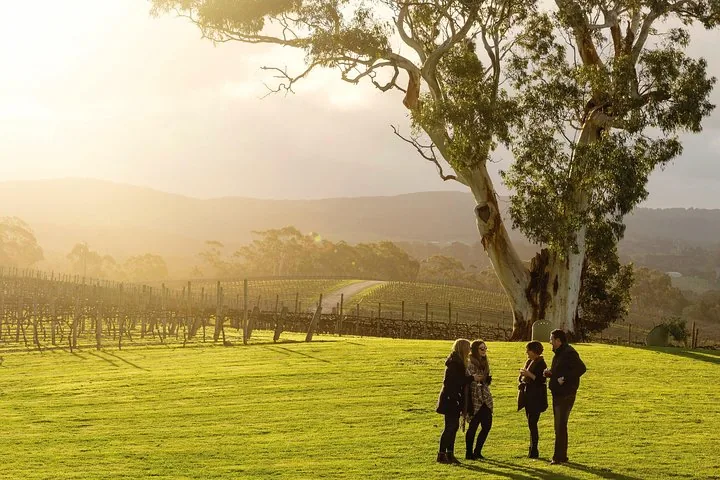
The vineyards change more through the year than the tasting rooms do. Autumn is the season Adelaide Hills Tourism builds its own guide around: from late March to May the vines, orchards and deciduous trees colour, and the favourite spots traditionally peak in mid to late April, from the golden rows of vines to the tree-lined main streets of Hahndorf and Stirling. By winter the vines are bare and dormant. New growth starts in spring, flowering follows in late spring, and by January the bunches are ripening for the next harvest.
| Month | Average high and low near Hahndorf | Rainy days | Days of 30°C or more | In the vineyards |
|---|---|---|---|---|
| January | 28°C and 13°C | About 4 | About 11 | Grapes ripening |
| February | 28°C and 13°C | About 4 | About 10 | Sparkling grapes often picked first |
| March | 25°C and 11°C | About 5 | About 7 | Vintage usually under way |
| April | 21°C and 9°C | About 7 | About 1 | Later picking; autumn colour |
| May | 17°C and 8°C | About 11 | None | Last colour, then leaf fall |
| June | 14°C and 6°C | About 13 | None | Bare vines, pruning |
| July | 14°C and 5°C | About 13 | None | Bare vines, pruning |
| August | 15°C and 5°C | About 13 | None | Bare vines |
| September | 17°C and 7°C | About 11 | None | New growth begins |
| October | 21°C and 8°C | About 8 | About 2 | Fresh green leaves |
| November | 24°C and 10°C | About 6 | About 5 | Flowering |
| December | 26°C and 11°C | About 6 | About 8 | Small green berries |
The temperatures are long-term averages for Mount Barker, about 7 km from Hahndorf at 359 m, so read them as a way to compare months, not as a forecast for your tour. A rainy day here means at least 1 mm of rain. Higher stops such as Mount Lofty Summit and the Piccadilly Valley run several degrees cooler, while the lower valleys around Hahndorf are close to these figures.
April and October have almost the same average high, about 21°C, so both suit a full day out. October brings about eight rainy days against seven in April, and the vineyards look quite different: fresh green leaves in October, the end of the harvest and the first gold in April.
Other experiences you might enjoy
Around Hahndorf, Mount Lofty and Stirling, and further out in the Barossa Valley, McLaren Vale and Adelaide itself, add food tours, wildlife experiences and other wine regions to your trip.
Vintage: when the grapes are picked
Vintage, the Australian word for the grape harvest, is a busy time at the wineries, with grapes arriving at the crush pad and a lot of activity in the sheds. In the Adelaide Hills grapes for sparkling wine come in first: Nepenthe, for one, picks its sparkling base at Balhannah in mid-February, at night while it is cool. Most of the harvest usually runs from mid-March into April, and cool seasons push it later.
The timing moves by weeks. In 2026 the regional wine association’s report said the season ran three to four weeks behind the long-term average, with harvest up to four weeks later than in the two seasons before it. If being there during vintage matters to you, aim for late March or early April, when picking is under way in most years. A standard tour visits tasting rooms rather than the vineyards being picked, so you are more likely to see a busy winery than the picking itself.
Autumn colour: late March to May
Adelaide Hills Tourism builds a whole autumn guide around the colour. It says the colour runs from late March to May and that its favourite spots traditionally peak in mid to late April: the main streets of Hahndorf and Stirling, the drive through the Piccadilly Valley, the lake at Mount Lofty Botanic Garden and the vineyards turning gold. It is also picking season for fruit, with figs, apples and the last of the strawberries at Beerenberg, whose patch outside Hahndorf usually opens from November to April.
Several day tours drive through Stirling or stop in Hahndorf, so an April tour shows you the colour without a separate drive. The timing shifts a little each year with the weather, so treat mid to late April as the usual peak, not a fixed date.
Summer heat and fire danger days
From December to February the Hills are warm to hot and dry. January’s average high at Mount Barker, near Hahndorf, is about 28°C, with about 11 days of 30°C or more and about five of 35°C or more. That is only a degree or two below Adelaide’s average high of about 30°C, so the Hills are not an escape from a hot day by daylight. Nights are where the difference shows: about 13°C near Hahndorf in January against about 18°C in the city, so evenings are pleasant. Mount Lofty Summit, at 685 m, is the cool exception, with January highs nearer 22°C.
Tastings are mostly indoors, so you feel the heat at vineyard stops, the summit lookout and on Hahndorf’s main street, and by mid-afternoon those can be tiring. Bring water, a hat and sunscreen. Some stops react to the heat too: one small-group tour’s listing says Woodside Cheese Cellar may close on days over 30°C, and Beerenberg says it can close its strawberry patch on hot days.
The Country Fire Service sets a fire danger season for the Mount Lofty Ranges each year. Recent seasons ran from 15 November 2024 to 14 May 2025, and from 1 December 2025 to 30 April 2026. The 2026 to 2027 season runs from 1 December 2026 to 30 April 2027. Cleland National Park, which includes the Mount Lofty Summit lookout, closes on Catastrophic fire danger days and may close on Extreme days, and one tour’s listing warns that Mount Lofty may be closed on extreme fire-risk days. If your date falls between 1 December 2026 and 30 April 2027, check the CFS rating the day before, and on an Extreme or Catastrophic day ask your operator what changes. The CFS Bushfire Information Hotline is 1800 362 361.
Summer has its own advantages: dry, settled weather, long days and the strawberry season at its height. Our summer wine tour guide compares the tour formats for a hot day.
Spring: September to November
Spring is the green season. September is still fairly wet, with about 11 rainy days near Hahndorf, but by October the average high is about 21°C, much like April, and the vineyards are in fresh leaf. November warms to about 24°C, with flowering in the vines and the strawberry patch at Beerenberg usually reopening. The state tourism site recommends spring for the Hills’ gardens, wildflowers and walks, so a spring tour suits anyone who wants green vineyards and a mix of tastings and time outdoors, with a layer for the showers.
Winter: June to August
Winter is cool, wet and quiet in the vineyards. Daytime highs are around 14°C and nights around 5°C near Hahndorf, so pack a warm, waterproof layer, and June to August bring about 13 rainy days a month, the most of the year. The vines are bare and being pruned, so there is no green canopy to see. A tasting inside a cellar door does not depend on the weather, and this is the season for slower tastings and long lunches; Petaluma’s riding and tasting experience, for one, finishes by the fire in the cooler months.
Two regional events frame the cooler months. The regional wine association runs Chardonnay May, a month of Chardonnay tastings and masterclasses at cellar doors with a passport trail, and Winter Reds in July, which it calls South Australia’s largest winter wine festival. The 2026 festival ran from 24 to 26 July with more than 45 events. Check the association’s events page for the next dates before you plan around either.
Holidays, weekdays and closures
Public holidays. Opening on public holidays varies by cellar door. Petaluma lists nine holidays when its cellar door is closed, including Good Friday, Christmas Eve, Christmas Day and Boxing Day, and the regional wine association keeps separate Christmas to New Year’s Eve and Easter opening-hours lists on its cellar door finder. For the 2026–27 holidays, see Adelaide Hills wineries at Christmas and New Year. In 2027 Good Friday falls on 26 March and Easter Monday on 29 March, inside the usual vintage window.
Weekdays. Some venues close on certain days of the week. Petaluma’s cellar door is open on Saturdays and Sundays only while improvement works take place, and one tour’s listing says Woodside Cheese Cellar is closed on Wednesdays. Tours plan their stops around this, so the venues on a given day can change.
Tour days. The hop-on hop-off tour runs daily from Adelaide, while its Hahndorf boarding option runs on Wednesdays, Fridays, Saturdays and Sundays, according to its listing. Check the days for the tour you want before you fix a date.
How busy are the Hills?
The South Australian Tourism Commission’s figures for 2024 put January and July as the strongest months for overnight visitors to the Adelaide Hills, at about 11% and 10% of the year’s total, both school-holiday months, and February and June as the lowest, at about 6% each. The commission says the summer and winter school holidays drive those peaks.
Two limits matter. Most visits are day trips: about 1.1 million in 2024 against 200,000 overnight visitors, and day trips are not in the monthly split. And the survey sample is small, so the commission treats regional figures as indicative. The figures show the shape of the year, not how full a tasting room will be; Shaw + Smith, for one, strongly recommends booking a tasting on busy weekends and public holidays.
Check your date
Choose a date to see any public holiday that can close cellar doors, what the vineyards are usually doing, and the weather: the forecast for Hahndorf for the next 16 days, or the long-term averages for that month at Mount Barker further ahead. In general, the hottest days fall from December to February, the main harvest usually runs from mid-March into April, and June to August are the wettest months.
Forecasts come from Open-Meteo. Averages are the Bureau of Meteorology’s 1991 to 2020 figures for Mount Barker, near Hahndorf, and are not a forecast. Between November and May, check the Country Fire Service fire danger rating the day before.
Choosing a tour for your month
The day tours on this site run for about five to eight hours from Adelaide, with cellar-door tastings, time in Hahndorf or both, and often lunch. The difference that matters by month is how firmly your date is fixed and how much of the day is outdoors.
If the forecast or your plans may change, a refundable booking helps. The Adelaide Hills and Hahndorf hop-on hop-off wine tour can be cancelled free up to 24 hours before, and you choose up to four stops on its loop, which suits a hot or wet day because you can stay longer indoors. The Small-Group Adelaide Hills and Hahndorf Hideaway is a full guided day for up to eight, with tastings at two cellar doors and a two-course German lunch in Hahndorf, but its listing says all sales are final, so book it once your date is fixed. In April and October, when the days are mild, the Hahndorf food and wine e-bike tour puts more of the day outdoors among the vines.
Choosing the month for a wider South Australia trip
If the tour is part of a wider South Australia trip, the state tourism site gives “Autumn for colour; spring for gardens, wildflowers and walks” as the time to go to the Adelaide Hills, and suggests Hahndorf, Stirling or Mount Barker as bases. The summer heat reaches Adelaide too, and winter is cool and wet there as well. Once your dates are fixed, a wine tour works in any month, and the checks for your day are heat, rain, fire danger and public holidays.
Sources and methodology
Sources and limits
Weather. Bureau of Meteorology climate statistics for Mount Barker, station 023733, at 359 m about 7 km south-east of Hahndorf, using the Bureau’s 1991 to 2020 averages. A rainy day counts 1 mm or more. Mount Lofty, station 023842, at 685 m on the summit, is used only as a reference for the higher ground; the Bureau has 20 years of temperature data for it inside 1991 to 2020. The Adelaide comparison uses the Bureau’s 1991 to 2020 averages for Kent Town, station 023090. The regional wine association’s figure of roughly 0.5°C for every 100 m of height is from its climate and soils page. No official station publishes averages for each sub-region, so the Piccadilly Valley and Lenswood are described only as higher and usually cooler.
Vines and vintage. Wine Australia’s SA Winegrape Crush Survey 2026, Adelaide Hills section, with the vintage report written for the Adelaide Hills Wine Region; Nepenthe’s own note on its sparkling base; and published vintage reports for earlier years describing the main harvest from mid-March into late April and later picking in cool seasons. No source publishes first and last picking dates for the region as a whole, so no single week is guaranteed.
Autumn colour and seasons. Adelaide Hills Tourism’s autumn page for the colour window and its favourite viewing spots; South Australia’s state tourism site for its when-to-go advice; Beerenberg’s strawberry-picking page for the patch season.
Visitors. South Australian Tourism Commission, Adelaide Hills regional profile for the year ending December 2024, from the National Visitor Survey. The monthly shares are for domestic overnight visitors only and do not include day trips. The commission notes that small samples make regional figures fluctuate. Nothing on this page counts visitors at a cellar door or on a tour.
Fire danger and closures. Country Fire Service announcements of fire danger season dates for the Mount Lofty Ranges, and the National Parks and Wildlife Service page for Cleland National Park. The 2026 to 2027 season dates, 1 December 2026 to 30 April 2027, are from the CFS fire danger season page, checked in November 2026. Tour itineraries and their heat and fire notes are from the operators’ listings on Viator.
Cellar doors, events and holidays. Petaluma’s cellar door page; the Adelaide Hills Wine Region’s events pages for Chardonnay May and Winter Reds and its cellar door finder; SafeWork SA’s list of South Australian public holidays for 2026 to 2028. Pages were read on 7 November 2026. Only some cellar doors were checked, so any venue’s own page is the final word.
What these figures cannot tell you. The temperatures and rainy days are long-term averages for one station near Hahndorf, not a forecast for your day, and higher stops run cooler. Rainfall totals do not say how long rain lasts on a given day. The harvest window comes from reports and producer notes, not a dated series for the whole region. The visitor figures are one year of a small survey that leaves out day trips, so they cannot say how busy a tasting room or tour will be. No monthly price series exists for Hills wine tours, so this page makes no cheapest-month claim, and no source counts how often tours change their itinerary for heat or fire danger.
Which format suits you is covered in which Adelaide Hills wine tour is right for you, the stops in the best Adelaide Hills wineries, and a full day planned out in our Adelaide Hills wine tour itinerary.
Frequently asked questions
What is the best month to visit the Adelaide Hills?
For a first wine-tasting trip, April offers the best overall balance. Daytime highs at Mount Barker, near Hahndorf, average about 21°C, so it is comfortable for a full day out, and the autumn colour in the vineyards and around Hahndorf and Stirling usually peaks in mid to late April. Picking is often still under way. If being there during vintage matters most, choose March, when picking is usually under way, but expect about 7 days of 30°C or more against about 1 in April.
When is vintage in the Adelaide Hills?
Vintage is the Australian word for the grape harvest. Grapes for sparkling wine are often picked first, from about mid-February, and most of the harvest usually runs from mid-March into April. The timing moves by weeks from year to year: the 2026 season ran three to four weeks behind the long-term average, according to the regional wine association's report in Wine Australia's crush survey.
What is the weather like in the Adelaide Hills?
Around Hahndorf, daytime highs average about 28°C in January and 14°C in July, and rain falls on about 13 days a month from June to August against about 4 to 6 a month in summer. Nights are much cooler than in Adelaide, at around 13°C in January. The higher ground around Mount Lofty Summit is cooler again, with January highs nearer 22°C, so pack a layer in any season.
Is the Adelaide Hills cooler than Adelaide?
Yes, but by how much depends on height. Around Hahndorf and Mount Barker, summer days average only a degree or two below Adelaide's, while nights are about 5°C cooler. At Mount Lofty Summit, 685 m up, January highs average about 22°C against about 30°C in the city. The wine region covers the Hills above 300 m, and the regional wine association puts the drop at roughly 0.5°C for every 100 m of height.
When do the autumn leaves change in the Adelaide Hills?
Adelaide Hills Tourism says the deciduous trees, orchards and vineyards colour from late March to May, with the favourite spots traditionally peaking in mid to late April. Hahndorf and Stirling's tree-lined main streets, the Piccadilly Valley and Mount Lofty Botanic Garden are among them. Timing shifts a little each year with the weather.
Is the Adelaide Hills worth visiting in winter?
Yes, if the tasting matters more to you than the vineyard views. From June to August daytime highs are around 14°C near Hahndorf, rain falls on about 13 days a month and the vines are bare, so the day is more about tastings and long lunches indoors. Winter Reds, the region's winter wine festival, is held in July; the 2026 festival ran from 24 to 26 July with more than 45 events.
Can hot weather or fire danger change an Adelaide Hills wine tour?
It can. Cleland National Park, which includes Mount Lofty Summit, closes on Catastrophic fire danger days and may close on Extreme days, and one small-group tour's listing says Mount Lofty may be closed on extreme fire-risk days and that Woodside Cheese Cellar may close on days over 30°C. From November to May, check the Country Fire Service rating the day before, and on an Extreme or Catastrophic day ask your operator what changes.
Are Adelaide Hills cellar doors open on public holidays?
Some close and some keep holiday hours, so check the venues you want. Petaluma, for example, lists nine public holidays when its cellar door is closed, including Good Friday, Christmas Day and Boxing Day, and the regional wine association publishes separate Christmas and Easter opening-hours lists. Some venues also close on certain weekdays, such as Woodside Cheese Cellar on Wednesdays. Our Christmas and New Year opening guide lists the known closures for 2026–27.
Book a Hills Wine Tour for Your Dates
The Adelaide Hills and Hahndorf hop-on hop-off tour runs a loop of cellar doors around Hahndorf, and it can be cancelled free up to 24 hours before the start.
Check Availability & Book